



Time management is one of the most misunderstood concepts because most people think it’s all about watching the clock and saving time. That couldn’t be farther from the truth. You see, watching the clock is not time management, it’s punctuality. Similarly, saving time is efficiency, which is different from time management. After all, you could be the most punctual or efficient person on the planet and still manage your time poorly.
The truth about time management is that it’s not actually about time; it’s about other skills like choosing priorities and setting goals. The majority of time management boils down to assessing which tasks need to happen when, and how those tasks fit into a broader project. Time management is also about understanding which blocks of time are most efficient for you, so you can use your time effectively. Time on the clock is only a tiny slice of time management as a whole. Ultimately, time management has little to do with time itself and more to do with making effective choices and being strategic with how you allocate your tasks.
For the next few weeks, I want to delve into different facets of time management. In particular, I see time management having four different areas:
- Choosing priorities (so you know what to tackle first)
- Setting goals (so you can see how small tasks fit the big picture)
- Assessing time quality (so you allocate your time effectively)
- Using the clock (so you can be more efficient with your time)
Today, I wanted to focus on the first topic—choosing priorities. I believe this is the most important element of time management, because it’s all about knowing which tasks to tackle and when to do them. If you get good at choosing priorities, your ability to manage your time will increase exponentially.
But, how do you choose those priorities in the first place? How do you know what tasks to tackle first, and which ones can wait until later? This decision comes down to a couple of different factors.
Task Urgency
Which task has the earliest deadline? What step needs to happen first, so other steps can come later? Which part of a project needs to be done right now? These are all questions relating to the urgency of a given task, and often this is our greatest motivator.
Most of us are driven by urgency. It’s hard to ignore a task when you have a big, glaring deadline hanging over your head. Yet, while urgency is an important factor to consider, we sometimes let it overshadow other factors, like a task’s importance or ease. In other words, we may sometimes get caught up working on unimportant tasks, simply because they are urgent and calling our attention.
Task Importance
Instead of focusing purely on task urgency, we must also consider task importance. This means looking not just at a task’s looming deadline, but also considering why the task matters. In particular, it’s important to think about how a given task contributes to your greater goals. For writers, for example, we might get caught up worrying about immediate deadlines (“Oh no! That newsletter has to go out tomorrow”) instead of giving priority to more important tasks (“I should spend some time writing my manuscript.”) This is where the Eisenhower Decision Matrix can come in handy.
Eisenhower Matrix
Developed by Dwight D. Eisenhower, this two-by-two matrix considers both task urgency and task importance together. To understand where a task falls on the matrix, all you need to do is ask two yes/no questions: (1) Is the task urgent? and (2) Is the task important? (See the diagram below.) You can use this matrix to figure out what course of action to take with a given task.
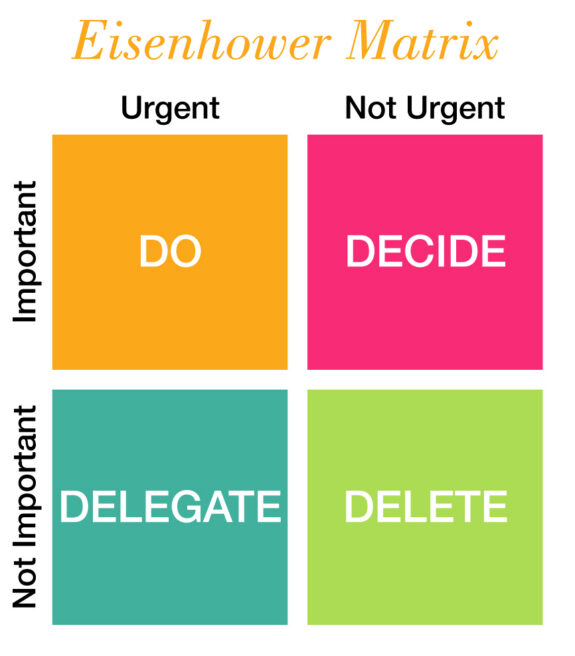
Depending on where the task lands on the matrix, you will handle it in a different way. If the task is urgent and important, you need to do it right away. If the task is important but not urgent, you need to decide on a time when you will work on it. Important-but-not-urgent tasks are most often the things that will move you closer to your long-term goals, but they are also the easiest tasks to fall by the wayside. If a task is urgent but not important, you should look for a way to delegate that task if at all possible. This will preserve your precious time for the things that really matter. Finally, if a task is neither important nor urgent, you can simply delete it from your to-do list and ignore it altogether.
There are two additional categories that I add to this model but do not appear on the matrix itself. You see, sometimes there’s just no way to delegate or delete a given task. You simply have to do it. In that case, see if you can delay or divide the task so you can buy yourself some extra time. For example, suppose you want to sit down and write but you also have to clean the house. You could hire a housekeeper to do the cleaning (delegate) or simply let the house get overrun with mess (delete), but for many, neither of those options is feasible or optimal. Instead, you could try to delay the cleaning for a few days, or divide the task so you do laundry on one day, clean the windows on another, and so forth.
If I were to recommend the one area of the matrix where you want to spend the most time, it would be the important-but-not-urgent or “decide” box, because those are the tasks that make the most long-term impact, but they are also the ones that are easiest to put off. Because they are not urgent, it’s easy for these tasks to fall to the bottom of the to-do list.
The area on the matrix where most people spend their time is the important-and-urgent or “do” box. This is because these tasks are important (so they can’t be easily delegated) but they are also urgent, so they require immediate attention. I call the “do” box the “swatting flies” box because when we spend too much time there, it often feels like we’re knocking out tasks as though we’re swatting flies. The problem with swatting flies, though, is that the minute we get rid of one, another one shows up.That’s why so many people who spend a lot of time in the “do” box tend to end up burnt out.
Task Ease
A third consideration which does not appear on the Eisenhower matrix is task ease. Sometimes the difficulty of a given task will affect the order in which we tackle it. For example, some people might prefer to knock out all the easy tasks first, to give themselves that fist-pump feeling of accomplishment and to help them build momentum. On the other hand, some folks might prefer to tackle a difficult task first, to get it out of the way and while their mind is still fresh. Regardless of which approach you take, it’s important at least to consider task ease when setting priorities.
This consideration is easily ignored, because it’s not as objective task urgency or importance. Yet I would argue that task ease might just be the most significant of all three components because it considers how you best handle your priorities. You see, priorities are highly personal and what might be nonnegotiable for one person might be less significant to someone else. This is why, when we choose our priorities, we have to allow for a little subjectivity and individuality. Task ease allows for some of that flexibility, as does task preference.
Task Preference
Let’s face it, some tasks are fun and don’t even feel like a burden. Other tasks are about as pleasant as getting a cavity filled. Just like task ease, task preference will vary wildly from one person to the next. Unlike task ease, however, I do think there is an optimal way to handle task preference.
While with task ease there are arguments for either doing easy or difficult tasks first, with task preference, I think the most effective way to do it is to tackle the most unpleasant task first. It’s easy to procrastinate on things we don’t like to do, but if we don’t get those unpleasant tasks done, they’ll just hang over our heads like a sword of Damocles. Instead, what I recommend is to knock out those unpleasant tasks and then reward yourself with the more pleasant ones.
What does this have to do with writing?
As writers, we often have to juggle competing tasks, both in the writing itself, and in the areas of our life that compete with writing. For many of us, life is continually at odds with our creative work and it’s filled with pragmatic responsibilities like going to a day job, cooking meals, cleaning the house, and taking care of kids or aging relatives. With all these things on our plates, we can’t magically make time appear out of nothing, but we can manage our priorities and find ways to put our writing higher up on that to-do list.
Ultimately, time management is not about creating more time—because that’s impossible. Rather, it’s about being more effective in how we use the time we have. This starts with choosing priorities and deciding which tasks you will do when.
Until next time, keep writing and keep being awesome!

P.S. For more info on Gabriela Pereira, the founder and instigator of DIY MFA, check out her profile page.


