




“Where do you get ideas?” Every writer has been asked that question at some point in their career. Sometimes it seems like new story ideas appear as if by magic. Other times it can feel like pulling teeth. So, how do we as writers get new story ideas? Let me give you a window into my creative process and maybe that will help spark some ideas for you!
The Oracle
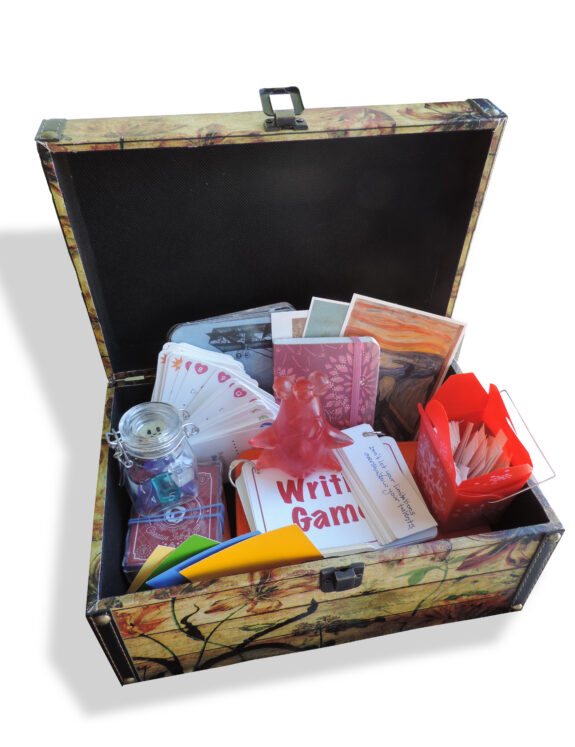
In my writing space, I have a box I lovingly call “The Oracle.” This is because it’s not unlike those oracles of old, where people would travel for miles to visit and get inspiration directly from the gods. My oracle is not nearly so grand—just a box with a latch, filled with random stuff—but it helps me come up with stories or develop ideas that are just a glimmer in my mind.
In the past, I’ve used a lot of the knick-knacks from my oracle as writing exercises for classes I’ve taught. Below is a picture of my oracle, and as you can see, it’s filled with random stuff. Let me give you a rundown of the creative tools I like to keep handy.
Dice
Dice are among the most useful tools to help you get ideas for stories and other projects. I use them in many different ways. I might assign a number to the words Who, What, When, Where, Why, and How, then roll a die, and depending on the number that comes up, I use that word to guide some freewriting I might do about a project. For example, if I roll a “Where” I might freewrite about the world of a current project and think about different aspects of the world-building. Or if I roll a “When” I might freewrite about different time-related aspects of my story. For example, I might play with the idea of doing multiple different timelines, or something like that.
Another way to use dice is to assign a different story alternative to each number. I brainstorm these ideas quickly, without thinking too hard about each individual one.
1 = the character goes camping
2 = the character travels abroad and writes a letter home
3 = the character gets called in for jury duty
Etc.
Then I roll the die and whatever number it lands on, that’s the thing I have to write. Then all I have to do is sit down and write a scene based on that situation.
The reason dice help me get inspired is because the outcome is totally random. I have no control over what the outcome might be and whatever number comes up, I have to roll with it and make it work. Any game of chance can work in this way, including flipping a coin. (Heads my character escapes through the secret door, tails they escape by climbing out the window.)
Randomness is precisely why games of chance are so useful for the creative process. They force us to make do with what we have in front of us, and we have to figure out a way to make it work. Sometimes having too many options available can be stifling to our creativity. It’s as though, with so many choices, we get stuck and end up choosing nothing. When we limit our choices, we actually make ourselves get more creative because we have to figure out how to make the available options work for us. So, when in doubt, keep some dice handy and use them to spark new, creative ideas.
Paint Chips
Often, when I start working on a new project, I go to a paint store and collect paint chips corresponding to the different characters in that story. I don’t have a super-scientific method for assigning colors to characters. Generally, I just go with whatever vibe I get from that character and what color seems to fit the best. Sometimes I’ll use color symbolism to assign colors to characters. For example, blue is symbolic of peace, so it might be a good fit for a character with a relaxed, calm personality. But most of the time, I just go with my gut and choose colors that “feel right” for the different characters in my story.
Why do I do this? I assign colors to characters because it allows me to get a sense for that character just by looking at that color. Rather than writing up long, elaborate character dossiers, simply assigning a color can often sum up a character’s personality so I get the gist at a glance. I find this to be a lot more efficient than spending hours upon hours writing up character descriptions and figuring out what my character’s favorite food is or who their third-grade teacher was, or what have you.
The other thing I find interesting is that oftentimes (usually without me even planning it) the relationship between the colors of certain characters can be emblematic of the relationships between those actual characters. For example, a lot of times I find that characters who are at odds with each other tend to have colors on opposite sides of the color wheel. These are colors that have a strong contrast with each other (though they can potentially look very good together). On the other hand, I sometimes find that characters who get along easily usually have colors that are close together or adjacent on the color wheel. These are usually tones from the same “color family” and they tend to look very harmonious together.
In other words, by assigning colors to different characters, I am able to get a sense for those characters’ personalities at a glance, and I can also get a feel for the relationships between those characters. Usually, characters with colors close together on the color wheel tend to get along, while characters who are on opposite sides of the color wheel tend to be at odds with each other.
So, next time you’re starting a new project, hop on over to the paint store and grab some color chips. You may be surprised at what you learn about your characters that way.
Word Box
You can see in the picture a small red box with little slips of paper inside. Each of those slips of paper contain a single word. I call this my word box.
I assembled this word box over the course of several months, just dropping in a couple of words each day as I felt inspired. Whenever I came across an interesting or unique word, I would write it on a slip of paper and put it in the box. After a few months, the box was filled and I was ready to start using it.
Here’s how the word box works: You choose 5-7 words at random and write a scene where you use all of those words. There is no other requirement about the scene in question, just that you use up all 5-7 words. This scene can become a part of your current project or it can be a standalone story or just a random practice exercise. The goal, though, is to use all of the words you’ve picked from the box.
This word box works similarly to the dice in that it limits your options and forces you to narrow your focus. Just as with dice, you have to work with whatever number you roll, here you have to be ready to make do with whatever random words you pull from the box.
The other thing that this technique does is that it forces you to stretch your creativity when you make connections between the words. For example, let’s suppose you pull the words “pirate” and “pumpkin.” These aren’t words that go together naturally, so you’ll have to get creative in how you make them work in the same scene. These types of random word associations force you to get creative and come up with unique solutions to make the combinations work.
Image File
Perhaps my favorite item in my oracle is the image file. This is a collection of photographs, postcards, and other images that I use to spark a story. Everywhere I go, I look for interesting things that make me think, “Wow, I bet there’s a story behind that.” I collect those images and put them together in a tin box. Some of the images I find are postcards of paintings or sculptures from museums. In fact, every time I go to a museum, I make sure to stop by the gift shop and look for some postcards to add to my image file.
I use the image file by pulling out a random picture and letting it spark a story idea. Sometimes that idea will directly relate to a project I’m working on. Sometimes it will lead me down a completely different path. The point is that the image is random and I can use it as a way not just to get inspiration but also to set limits on my creativity. By forcing myself to use an image to spark a story, I have to get creative about how I will draw a narrative from that picture. The picture sets constraints—not unlike the dice or word box—and I have to work within those constraints in order to make the story work.
Just like the word box, it can take a little bit of time to build up a juicy image file. To get started, choose a container where you will store the images. (I use an old tin candy box with a hinged lid.) Then start looking around for images. Some of these images might be snapshots you take with your phone while you’re out and about. Some of them might be postcards you pick up at museums or galleries. Some might even be pictures you clip out of magazines. See if you can collect at least one image per day for an entire month, and by the end of that time you’ll have amassed a big enough collection that you can start to use it.
Conclusion
These are just a couple of tools and techniques that I keep handy in my oracle. You may choose to add other things to your writer’s toolkit, and that’s fine too. The goal is that you have at least three or four different tools handy that spark your creativity and help you generate story ideas. And remember, it can take time to assemble all these tools, so be patient and put in the time and effort. It will be well worth your while.
Until next time, keep writing and keep being awesome!

P.S. For more info on Gabriela Pereira, the founder and instigator of DIY MFA, check out her profile page.


